A nuclear reactor coolant system removes the intense heat generated by fission and transfers it — safely and reliably — to a turbine or heat exchanger that produces electricity. Without an effective coolant, fuel temperatures would rise uncontrollably within seconds, turning a controlled chain reaction into a meltdown. From ordinary light water to exotic liquid metals and molten fluoride salts, each coolant choice shapes every other design decision in the reactor: pressure vessel thickness, fuel geometry, safety systems, and even the type of turbine used downstream.
Key Takeaways
- Coolant systems do two jobs simultaneously: they remove fission heat and, in most designs, also moderate (slow) neutrons to sustain the chain reaction.
- Pressurized water reactors (PWRs) and boiling water reactors (BWRs) together account for roughly 80% of all operating commercial reactors worldwide.
- Advanced coolants — including liquid sodium, molten salt, lead-bismuth, and supercritical water — are the defining feature of most Generation IV reactor concepts.
- The physical and chemical properties of a coolant (boiling point, neutron absorption, corrosiveness, heat capacity) determine its operational advantages and engineering challenges.
Why the Coolant Is the Heart of Reactor Design
Nuclear fission releases energy primarily as heat — roughly 200 MeV per fission event. In a commercial reactor operating at 1,000 megawatts of thermal power, that heat must be extracted continuously and converted to electricity. The coolant is the working fluid that accomplishes this, flowing through or around fuel assemblies, absorbing heat, and carrying it away. In most designs, the coolant also serves as a neutron moderator, slowing fast neutrons down to thermal (slow) energies where they are far more likely to trigger additional fissions and sustain the chain reaction.
Choosing a coolant is therefore not a single engineering decision — it is a cascade of decisions that determines operating pressure, the likelihood of a loss-of-coolant accident, passive safety behavior, fuel compatibility, materials corrosion, and ultimately cost. Understanding each major coolant type reveals why nuclear engineering is one of the most constraint-dense disciplines in existence.
Light Water: The Dominant Choice
Pressurized Water Reactors (PWR)
The pressurized water reactor is the most common reactor design on Earth, representing about 70% of the global fleet. Ordinary light water (H₂O) is pumped through the reactor core at very high pressure — typically around 155 bar (2,250 psi) — which keeps it liquid even at temperatures approaching 325°C. This superheated water flows through a steam generator, where it transfers heat to a secondary loop that actually boils and drives the turbine. The two loops never mix, which keeps the turbine side free of radioactive contamination.
Light water is cheap, abundant, and an excellent neutron moderator, but it absorbs some neutrons, which means PWR fuel must be enriched to around 3–5% uranium-235 to sustain criticality. The high operating pressure is a structural challenge, requiring thick steel pressure vessels and robust safety systems designed around loss-of-coolant accident (LOCA) scenarios.
Boiling Water Reactors (BWR)
The boiling water reactor simplifies the PWR concept by allowing the coolant to boil directly inside the reactor vessel. Steam produced in the core goes straight to the turbine, eliminating the steam generator entirely. This reduces capital cost and complexity, but it means the turbine handles mildly radioactive steam, requiring additional shielding and complicating maintenance. BWRs operate at lower pressure than PWRs (around 75 bar) but are more complex to control because the fraction of steam bubbles (void fraction) in the core directly affects reactivity, creating a coupling between power output and coolant behavior.
Heavy Water: The Canadian Approach
Heavy water (D₂O, where hydrogen is replaced by deuterium) absorbs far fewer neutrons than ordinary light water. This extraordinary property allows CANDU reactors — the primary heavy water design — to run on natural, unenriched uranium, eliminating the need for enrichment facilities entirely. CANDU reactors also allow on-line refueling, meaning fuel can be added and removed while the reactor runs at full power. The trade-off is cost and complexity: heavy water is extremely expensive to produce and must be carefully managed to prevent dilution with ordinary water. Canada, India, South Korea, Argentina, Romania, and China all operate heavy water reactors.
Gas Coolants: High Temperature, High Efficiency
Carbon Dioxide (Magnox and AGR)
The United Kingdom built most of its early commercial nuclear fleet around CO₂-cooled reactors. Magnox reactors used natural uranium metal fuel clad in magnesium alloy, cooled by CO₂ at modest temperatures. Advanced Gas-cooled Reactors (AGRs) pushed temperatures higher, achieving thermodynamic efficiencies that rival modern combined-cycle gas plants. Gas coolants never risk a steam explosion, are transparent to neutrons, and produce no phase-change complications. However, gas has a much lower heat capacity per unit volume than liquid coolants, requiring large, powerful circulators and high-pressure operation.
Helium (High-Temperature Gas Reactors)
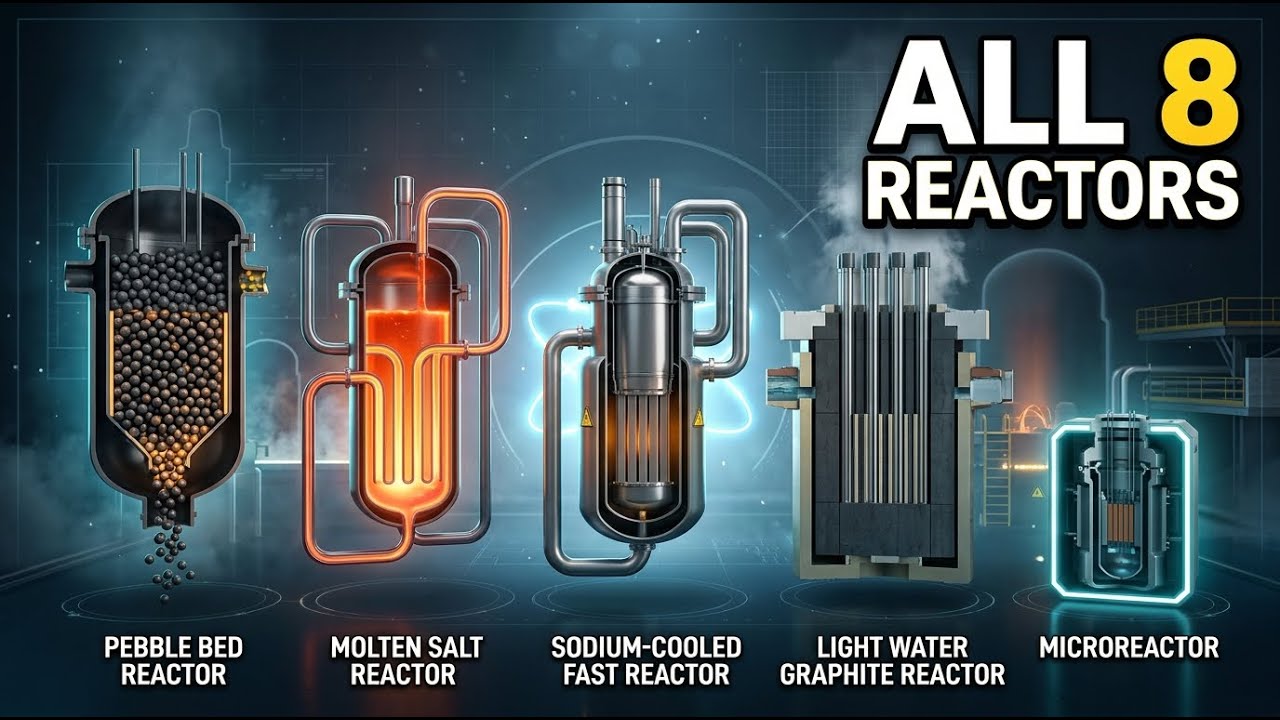
Helium is chemically inert, has excellent neutron transparency, and remains gaseous at any temperature achievable in a reactor. High-Temperature Gas-cooled Reactors (HTGRs) using helium can operate at outlet temperatures of 700–950°C — far hotter than any water-cooled design. This makes them attractive for direct industrial heat applications like hydrogen production and chemical processing, not just electricity generation. TRISO (tristructural isotropic) fuel particles, each a tiny ceramic-coated uranium sphere, are the fuel form of choice. China's HTR-PM, which began commercial operation in 2023, is the first modern pebble-bed gas reactor to reach the grid.
Liquid Metal Coolants: The Fast Reactor Family
Liquid Sodium
Sodium melts at 98°C and boils at 883°C, giving liquid-sodium-cooled fast reactors an enormous temperature operating window without any pressurization. Because sodium absorbs very few neutrons, these reactors operate with a 'fast' neutron spectrum, enabling them to breed new fissile material from uranium-238 and to 'burn' long-lived nuclear waste — two capabilities that no water-cooled reactor can match. The challenges are significant: sodium burns violently on contact with air or water, requiring inert-gas cover and careful secondary-loop isolation, and it becomes highly radioactive after neutron activation. Russia's BN-800 fast reactor and the under-construction BN-1200 are the most advanced operational examples.
Lead and Lead-Bismuth Eutectic
Lead and the lead-bismuth eutectic (LBE) alloy are heavier liquid metal alternatives with important safety advantages: they do not react with water or air, have very high boiling points (1,740°C for lead), and lead's high atomic mass provides excellent neutron shielding. Russia developed lead-bismuth reactors for submarine propulsion, accumulating decades of operational data. The main challenges are high density (placing enormous structural loads on the reactor vessel), the production of toxic polonium-210 from bismuth activation in LBE systems, and corrosion of structural steels. Several Generation IV projects, including the ALFRED demonstrator in Europe, are advancing lead-cooled fast reactor technology.
Molten Salt: The Dissolved-Fuel Paradigm
Molten salt reactors (MSRs) represent a fundamentally different philosophy: instead of solid fuel cooled by a fluid, the fuel is dissolved directly into the liquid salt coolant, which circulates through the core. Fluoride or chloride salt mixtures remain liquid at temperatures of 500–700°C at atmospheric pressure — no pressurized vessel required. The Oak Ridge National Laboratory operated the Molten Salt Reactor Experiment (MSRE) successfully from 1965 to 1969. Modern MSR developers like Terrestrial Energy, Moltex Energy, and Thorium Tech Solution are pursuing designs that can use thorium as a fertile fuel and breed fissile uranium-233, potentially unlocking vast thorium reserves. Ongoing challenges include materials corrosion, tritium management, and the complexity of on-line fuel reprocessing.
Supercritical Water: Steam Turbines Without the Steam Generator
If water is heated above 374°C and pressurized above 221 bar, it enters a supercritical state where there is no distinction between liquid and vapor. Supercritical water-cooled reactors (SCWRs) exploit this to achieve very high thermodynamic efficiency — potentially 45% or more, compared to roughly 33% for a conventional PWR. The supercritical fluid flows directly from the reactor to the turbine, eliminating the steam generator entirely. The primary challenge is materials: supercritical water is intensely corrosive, and no reactor-grade material has yet been qualified for long-term service under these conditions. SCWRs remain a Generation IV concept under active research in Canada, Europe, and China.
Comparing Coolants: A Systems Perspective
Each coolant system embodies a different set of engineering trade-offs. Light water is safe, well-understood, and cheap, but limits efficiency and requires enriched fuel. Gas coolants enable very high temperatures but suffer from low volumetric heat capacity. Liquid metals unlock fast-spectrum breeding and waste burning but introduce handling hazards. Molten salts offer atmospheric-pressure operation and fuel flexibility but demand new materials science. No single coolant is universally superior — the 'best' choice depends on what the reactor is intended to accomplish, whether that is bulk electricity generation, industrial heat supply, weapons material disposition, or fuel breeding for a growing fleet.