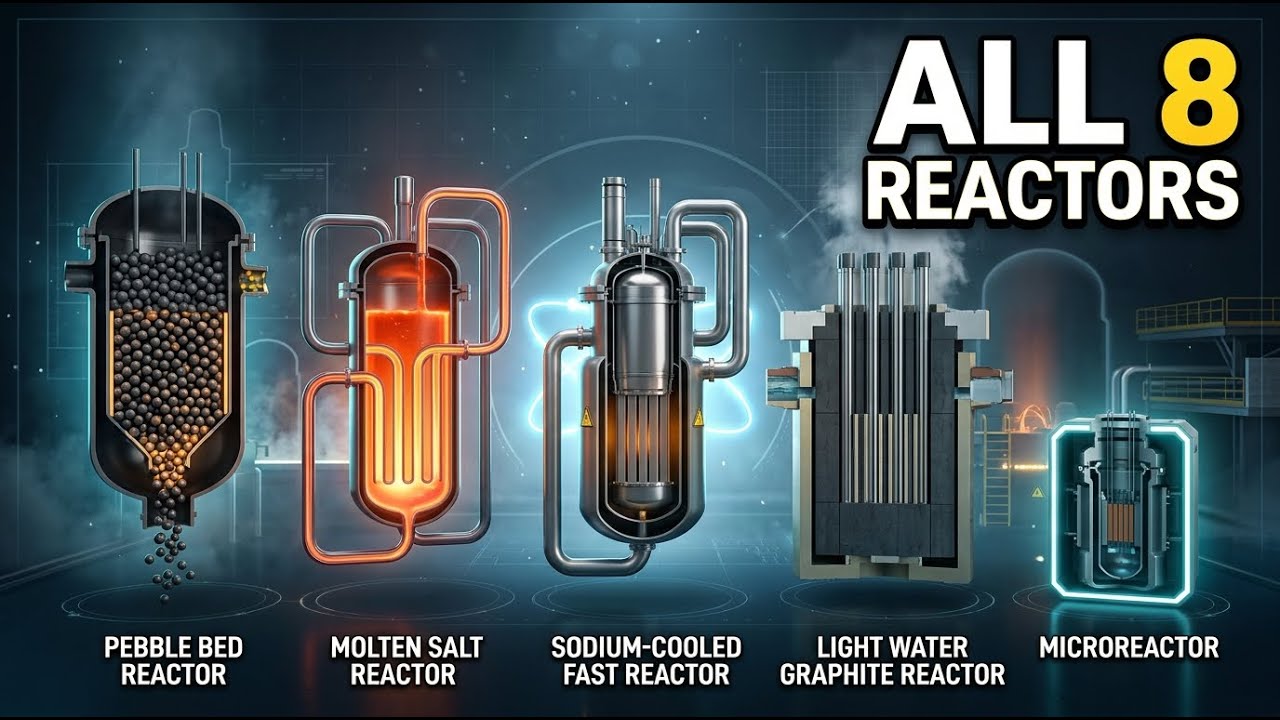
The RBMK reactor caused the Chernobyl disaster because of a fundamental design flaw known as a positive void coefficient, which caused the reactor to become more reactive — not less — as it overheated. This instability, compounded by a catastrophic defect in the control rod design, turned a routine safety test on April 26, 1986 into a steam explosion that blew the roof off Reactor 4 and scattered radioactive debris across Europe. Understanding the RBMK's physics is understanding exactly why Chernobyl was not just an operator error, but an accident waiting to happen.
Key Takeaways
- The RBMK reactor had a positive void coefficient, meaning it became more reactive as cooling water turned to steam — the opposite of safe reactor behavior.
- The control rods used graphite tips that momentarily spiked reactor power when inserted, rather than immediately dampening the reaction.
- Soviet authorities knew about both flaws before Chernobyl but classified the information, leaving operators unaware of the true risks.
- The Chernobyl explosion was a prompt criticality event — an uncontrolled, near-instantaneous nuclear chain reaction far beyond any designed operating limit.
What Is the RBMK Reactor?
RBMK stands for Reaktor Bolshoy Moshchnosti Kanalnyy, which translates roughly as 'high-power channel-type reactor.' It was a Soviet-designed graphite-moderated, water-cooled reactor that first came online in 1954 and became the backbone of the USSR's civilian nuclear power program throughout the 1970s and 1980s. Sixteen RBMK reactors were eventually built, and several remain in operation in Russia today, having been substantially modified after Chernobyl.
The RBMK had genuine advantages from a Soviet industrial perspective. It could be refueled while running at full power — no need to shut down and cool the entire core. It could also use unenriched or lightly enriched uranium fuel, which reduced dependence on expensive isotope separation infrastructure. These practical benefits made it attractive to Soviet planners, even as Western reactor designers took a different path toward pressurized water reactors with inherently safer feedback characteristics.
The Physics of the Positive Void Coefficient
To understand the RBMK's fatal flaw, you need to understand how nuclear reactors are supposed to control themselves. In a well-designed reactor, if the coolant water begins to boil and form steam bubbles — called 'voids' — the reactor should automatically slow down. This is called a negative void coefficient. Water in these reactors acts as both a coolant and a neutron moderator, meaning it slows neutrons down to the energies needed to sustain fission. When it boils away, fewer neutrons are moderated, fission slows, and the reactor cools itself. It is a built-in safety mechanism, an elegant piece of passive physics.
The RBMK worked differently. It used solid graphite as its primary neutron moderator, arranged in a massive lattice structure surrounding vertical fuel channels through which cooling water flowed. Because graphite — not water — was doing most of the moderating, the loss of water actually increased reactivity. With less water absorbing neutrons, more of them reached the graphite moderator and sustained or accelerated the chain reaction. This is the positive void coefficient: as coolant turns to steam, power goes up, which creates more steam, which raises power further — a runaway feedback loop with no natural brake.
The effect was especially severe at low power levels. At high power, the RBMK was more stable. But when the reactor was throttled down — as it was during the April 26 safety test — the positive void coefficient became dangerously amplified. This is precisely the operating regime in which Reactor 4 found itself in the early hours of that morning.
The Control Rod Design Defect
If the positive void coefficient was the underlying disease, the control rod design was the mechanism of death. RBMK control rods were inserted from the top of the reactor to absorb neutrons and slow the chain reaction. In an emergency, operators would trigger an emergency shutdown — called AZ-5 in Soviet notation — causing all 211 control rods to drop simultaneously into the core.
The problem was at the tip of each rod. The bottom 1.25 meters of every control rod was made of graphite, not neutron-absorbing material. This was a design compromise to reduce the length of the rod assembly. When the rods began to descend, the graphite tips entered the lower portion of the reactor core first. For a critical few seconds, instead of absorbing neutrons, those graphite tips were displacing water and moderating additional neutrons — spiking local reactivity in exactly the zones where the reactor was already running hot.
This phenomenon was known as the 'positive scram effect.' When operators hit the emergency shutdown button, they were, for 3 to 4 seconds, making the situation worse. Soviet nuclear physicists had identified this problem before Chernobyl. A report highlighting the danger had been written and classified. The operators at Chernobyl's Reactor 4 had never seen it.
The Night of April 26, 1986
The Chernobyl safety test was designed to measure how long the turbines could generate emergency power after a reactor shutdown — a practical question for backup systems. The test had been delayed multiple times, and when it finally ran in the early hours of April 26, the reactor had been forced into an unstable low-power state after an unplanned power drop nearly killed the reaction entirely.
Operators had withdrawn almost all control rods to recover power — a configuration that violated operating procedures and left virtually no margin for control. The reactor was producing around 200 megawatts thermal, far below its designed operating range of 700 to 1,600 megawatts, and deep in the regime where the positive void coefficient was most dangerous. Cooling water was close to its boiling point throughout the core.
When the test began and coolant flow was reduced, steam voids began forming rapidly. Reactivity climbed. Sensing the surge, the shift foreman ordered the AZ-5 emergency shutdown. The control rods began to fall. The graphite tips entered the core. Power spiked to an estimated 30,000 megawatts — roughly 10 times the reactor's maximum rated output — in a matter of seconds. The fuel fragmented, water flashed to steam, and a steam explosion tore the 1,000-tonne reactor lid off its mountings. A second explosion — likely a prompt criticality event — followed almost immediately, blowing the core apart and igniting the graphite moderator.
What Soviet Engineers Knew — and Hid
The most troubling dimension of the Chernobyl story is not that the RBMK had flaws. All engineered systems have flaws. It is that the flaws were known and deliberately concealed. Soviet nuclear culture operated under a dual pressure: to maintain the prestige of Soviet technology and to avoid shutting down reactors that the national grid depended upon. Acknowledging the positive void coefficient or the positive scram effect would have required either major design retrofits or significant operational restrictions — both costly in time and resources.
Internal analyses from as early as 1983 had flagged the control rod tip problem. The fixes required — replacing graphite tips with neutron absorbers, adding neutron absorber sections at the bottom of channels, and raising the minimum control rod count — were eventually implemented after Chernobyl. But before the disaster, the information was marked secret and operators remained in the dark, trained to follow procedures built around a reactor whose true behavior had never been honestly disclosed to them.
Legacy and Lessons
The Chernobyl disaster triggered a fundamental reassessment of nuclear safety culture worldwide. The concept of 'defense in depth' — multiple independent barriers between a reactor and the environment — was tightened globally. The International Atomic Energy Agency expanded its safety peer-review programs. Western regulators, who had long maintained that a Chernobyl-type accident could not happen in their reactor designs, used it as a prompt to audit their own assumptions.
For the RBMK specifically, surviving reactors were modified to reduce the positive void coefficient by increasing uranium enrichment levels, adding additional fixed neutron absorbers, and replacing the graphite-tipped control rods. The minimum operational control rod count was raised substantially. These changes made the design significantly safer, though most Western nations have never operated an RBMK and have no plans to do so.
The deeper lesson of Chernobyl is not simply about reactor physics. It is about what happens when safety information is subordinated to institutional interests — when engineers know something is wrong and the system prevents them from saying so clearly enough that it changes behavior. The RBMK's positive void coefficient was physics. The concealment was a choice.