Nuclear propulsion works by using the immense energy released from nuclear reactions — fission, fusion, or annihilation — to accelerate propellant to velocities far beyond what any chemical rocket can achieve. Where the best chemical engines top out at a specific impulse around 450 seconds, nuclear thermal rockets can exceed 900 seconds, and more advanced concepts push into the tens of thousands. Understanding these systems means understanding why engineers have been drawn to nuclear propulsion since the 1950s and why it remains the most credible path to rapid deep-space travel, crewed Mars missions, and interstellar probes.
Key Takeaways
- Nuclear thermal rockets like NERVA achieve roughly twice the specific impulse of the best chemical engines by heating hydrogen propellant in a fission reactor rather than burning fuel.
- Project Orion proposed detonating nuclear bombs behind a spacecraft — a theoretically workable design that could have delivered massive payloads to Mars in weeks.
- Fusion and antimatter drives remain theoretical but promise specific impulses orders of magnitude beyond any fission system, potentially enabling interstellar travel.
- Specific impulse (Isp) is the key performance metric: higher Isp means less propellant needed for the same delta-v, which is critical for deep-space missions.
Why Chemical Rockets Hit a Wall
Every rocket obeys the Tsiolkovsky rocket equation: the delta-v a vehicle can produce depends logarithmically on its mass ratio and linearly on its exhaust velocity. Chemical rockets are fundamentally limited because their energy source is also their propellant — you can only extract so much energy from molecular bonds. Liquid hydrogen and liquid oxygen, the most energetic chemical combination, produce an exhaust velocity around 4,400 meters per second. Nuclear reactions release energy roughly a million times more densely than chemical ones, which is why nuclear propulsion has occupied serious aerospace engineers for over seventy years.
Nuclear Thermal Rockets: Heating Propellant with Fission
The most straightforward nuclear propulsion concept heats a propellant — almost always liquid hydrogen — by passing it through or around an operating fission reactor. The hot hydrogen is then expelled through a conventional nozzle. There is no combustion; the reactor is purely a heat source. This approach is called a nuclear thermal rocket (NTR), and it achieves a specific impulse roughly double that of chemical rockets because hydrogen, being the lightest molecule, reaches very high exhaust velocities when heated to extreme temperatures.
Solid-Core NTR and NERVA
The solid-core NTR is the most developed nuclear rocket concept in history. The reactor core is built from high-temperature materials — typically graphite or ceramic carbides — with channels through which hydrogen propellant flows. The fuel heats the hydrogen, which then expands out the nozzle. The core temperature is limited by the melting point of the structural materials, capping exhaust temperatures around 2,700 Kelvin and specific impulse around 850–900 seconds.
NERVA — the Nuclear Engine for Rocket Vehicle Application — was the United States program that brought this concept closest to flight. Between 1959 and 1972, engineers tested a succession of engines at Jackass Flats, Nevada, accumulating over 100 minutes of full-power operation across multiple tests. The Phoebus 2A test in 1968 ran a reactor at 4,100 megawatts of thermal power. NERVA was cancelled not for technical failure but for budget cuts after Apollo. The engineering was real and the hardware worked.
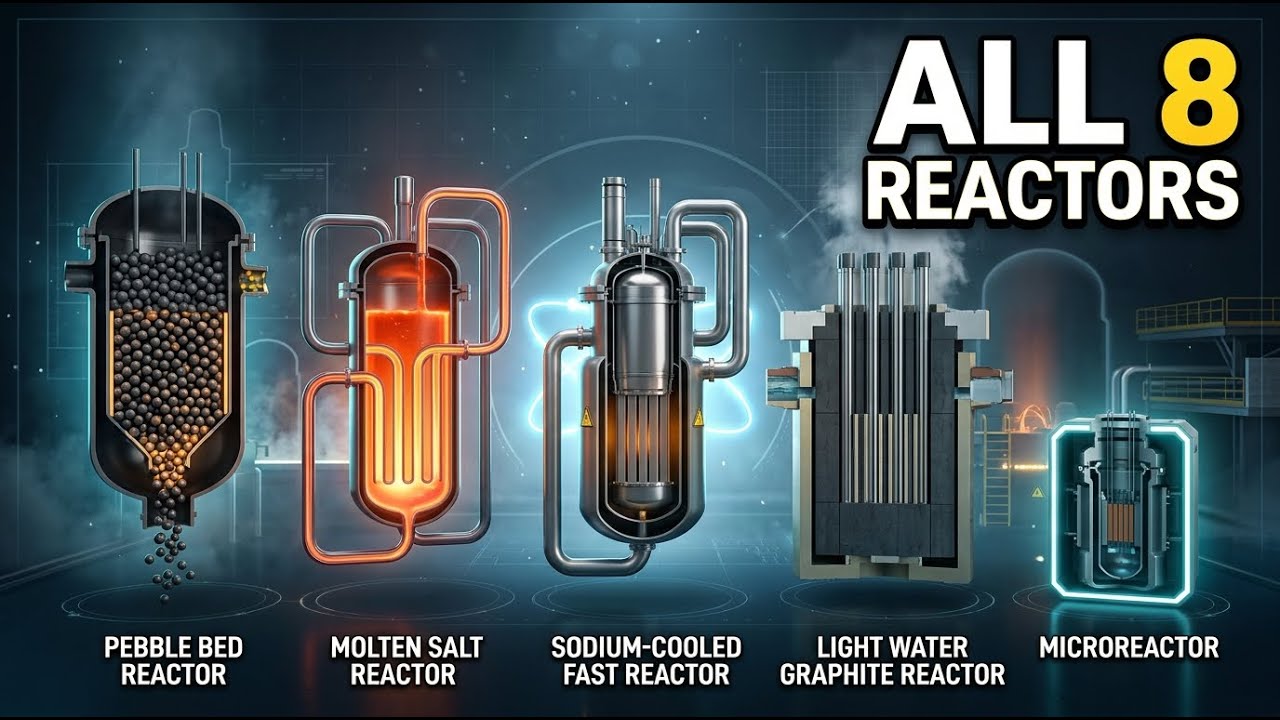
Pebble-bed reactors offer a variation on the solid-core theme: rather than a monolithic graphite block, the core consists of thousands of fuel-bearing spheres through which propellant flows. This design offers better heat transfer and may be more tolerant of structural stress, though it introduces complexity in terms of pebble management and potential blockages.
Liquid-Core and Gas-Core: Dissolving the Limits
The temperature ceiling of solid-core NTRs is dictated by materials science — you cannot heat the core hotter than it can structurally survive. Liquid-core designs dissolve this constraint by allowing the nuclear fuel itself to melt. The fissioning fuel operates as a liquid, achieving temperatures around 5,000–8,000 Kelvin and pushing specific impulse toward 1,300–2,000 seconds. The engineering challenge is containing a liquid that is simultaneously radioactive, extremely hot, and chemically aggressive.
Gas-core rockets take this further still. The uranium fuel operates as a high-pressure gas plasma at temperatures around 20,000–50,000 Kelvin, and hydrogen propellant flows around or through this plasma, absorbing heat before exhausting through the nozzle. In the 'open-cycle' gas-core design, some uranium inevitably escapes with the exhaust — a significant problem both for efficiency and radiation contamination. The 'closed-cycle' or nuclear light bulb design attempts to contain the fissioning plasma behind a transparent quartz wall while letting radiation pass through to heat the propellant. This concept promises specific impulses of 1,500–3,000 seconds but has never been built or tested at power.
Project Orion: The Nuclear Pulse Rocket
Project Orion, developed from 1958 through the early 1960s primarily by Ted Taylor and Freeman Dyson at General Atomics, took a radically different approach. Instead of using a reactor to heat propellant continuously, Orion proposed detonating a series of small nuclear bombs behind the spacecraft, with the resulting plasma and radiation pressure pushing against a massive steel pusher plate connected to the vehicle through shock absorbers.
The engineering logic, as brutal as it sounds, is sound. Each pulse delivers an enormous impulse, and by repeating detonations at regular intervals — perhaps one bomb per second — the spacecraft accelerates smoothly. Specific impulse estimates ranged from 2,500 seconds for near-Earth versions to over 100,000 seconds for interstellar variants using thermonuclear bombs. Dyson calculated that an Orion ship could reach Mars in four weeks and the moons of Saturn in a year. A version studied during the program could have carried 300 tons of payload to Mars on a first mission.
Orion was killed by the 1963 Partial Test Ban Treaty, which prohibited nuclear detonations in space, in the atmosphere, and underwater. The concept is technically credible but politically and environmentally untenable in any near-term scenario. A variant called Medusa, proposed later, would have the spacecraft towed by a large sail pushed by the nuclear pulses rather than a rigid plate.
Nuclear Electric Propulsion
Rather than using nuclear energy to heat propellant directly, nuclear electric propulsion (NEP) uses a reactor to generate electricity, which then powers an electric thruster — typically an ion engine or Hall-effect thruster. Ion thrusters accelerate propellant (usually xenon) to exhaust velocities of 20,000–80,000 meters per second, yielding specific impulses of 2,000–8,000 seconds. The trade-off is thrust: ion thrusters produce very low thrust, measured in millinewtons, so they accelerate slowly even if they are ultimately very efficient.
NEP is best suited for robotic probes and cargo missions where travel time is flexible. A nuclear reactor in space can produce tens or hundreds of kilowatts to megawatts of continuous electrical power — far more than any solar array beyond the inner solar system. NASA's Kilopower project demonstrated small fission reactors for this purpose, and the concept of using a reactor-powered ion drive for a Jupiter or Saturn orbiter remains actively studied.
Fusion Rockets and Direct Fusion Drive
Fusion propulsion aims to harness the energy released when light nuclei — typically deuterium and helium-3, or deuterium and tritium — fuse together. Fusion releases several times more energy per kilogram than fission and produces far less radioactive waste. A fusion rocket could theoretically achieve specific impulses of 10,000–100,000 seconds with meaningful thrust, enabling transit times to Mars measured in weeks and journeys to the outer solar system in months rather than years.
The problem is that controlled fusion has not yet been achieved at net energy gain in a practical device, though NIF's laser fusion experiments and private companies like TAE Technologies and Commonwealth Fusion Systems have made real recent progress. Direct Fusion Drive (DFD), developed at Princeton Plasma Physics Laboratory, proposes using a compact field-reversed configuration fusion reactor that simultaneously produces thrust and electricity. If it works, it would deliver both high Isp and enough power for spacecraft systems — a uniquely versatile solution. DFD remains pre-experimental but is based on real plasma physics.
Fission Fragment Rockets and Antimatter Drives
The fission fragment rocket takes an extreme approach: rather than using fission energy to heat a separate propellant, it directly expels the fast-moving fragments produced by fissioning nuclei as the propellant itself. Fission fragments travel at roughly 3–5% the speed of light, yielding theoretical specific impulses in the millions of seconds. The engineering challenges are extraordinary — containing a fissioning plasma while extracting the fragments efficiently — but the physics is unambiguous.
Antimatter drives represent the theoretical pinnacle of propulsion. When matter meets antimatter, 100% of the mass converts to energy via E=mc², releasing energy roughly a billion times more densely than chemical reactions and ten times more than fusion. Even a few micrograms of antihydrogen annihilating with hydrogen could propel a spacecraft to the outer solar system. The obstacle is production: the world's particle accelerators produce nanograms of antihydrogen per year at costs of tens of billions of dollars per gram. Until production scales by many orders of magnitude, antimatter propulsion remains a thought experiment — but a physically valid one.
Comparing the Systems
Ranked by specific impulse from lowest to highest: solid-core NTR (800–900 s), liquid-core NTR (1,300–2,000 s), gas-core NTR (1,500–3,000 s), nuclear electric with ion propulsion (2,000–8,000 s), Project Orion (2,500–100,000 s), fusion drives (10,000–100,000 s), fission fragment (1,000,000+ s), and antimatter (tens of millions of seconds). Thrust, readiness level, and political feasibility scramble this ranking considerably. NERVA-class solid-core NTRs are the only systems with a substantial test record and a realistic near-term development path.