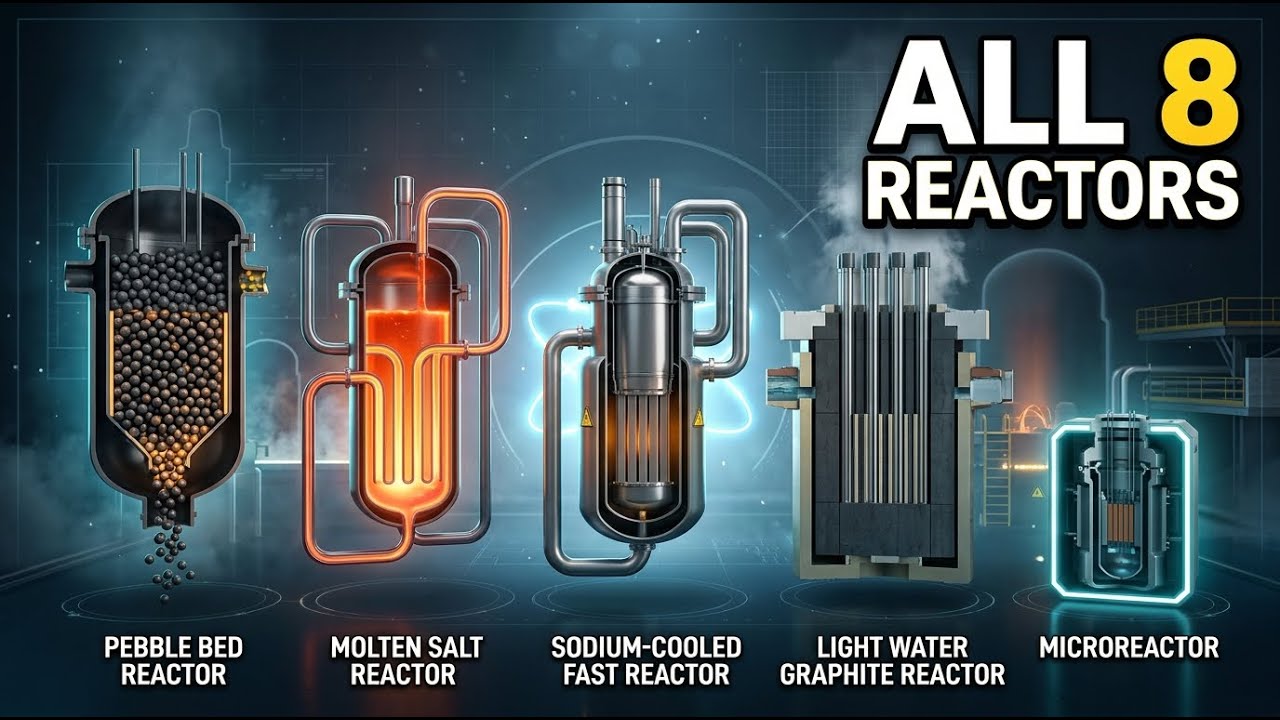
A molten salt reactor (MSR) is a type of nuclear reactor that uses molten fluoride or chloride salt as either the fuel carrier, the coolant, or both — allowing it to operate at high temperatures without the enormous pressures required by conventional water-cooled reactors. Unlike solid-fuel designs that depend on fuel rods and pressurized water loops, MSRs circulate a liquid mixture that can, in certain designs, drain passively into a safe containment tank the moment something goes wrong. This combination of high thermal efficiency, low operating pressure, and passive safety features has made molten salt reactor technology one of the most actively researched advanced nuclear concepts in the world today.
Key Takeaways
- Molten salt reactors use liquid salt as fuel carrier, coolant, or both, eliminating the need for solid fuel rods and high-pressure water systems.
- The freeze plug is a deliberately cooled section of solidified salt that melts if the reactor overheats, triggering a passive gravity drain into a safe tank.
- MSRs operate at atmospheric or near-atmospheric pressure, dramatically reducing the risk of explosive steam releases that threaten conventional light-water reactors.
- The original Molten Salt Reactor Experiment at Oak Ridge National Laboratory ran successfully from 1965 to 1969, proving the concept works in practice.
What Makes a Molten Salt Reactor Different?
Most of the world's operating nuclear reactors are light-water reactors (LWRs). In these designs, solid uranium fuel pellets are packed into metal rods, and ordinary water under pressures of roughly 150 atmospheres carries heat away from the core. That extreme pressure is a fundamental safety liability — if containment fails, superheated water flashes instantly into steam, creating the explosive force that can rupture containment structures.
Molten salt reactors take a radically different approach. The fuel — typically uranium or thorium fluoride salts — is dissolved directly into a molten fluoride salt mixture, most commonly a lithium-beryllium fluoride compound called FLiBe. This liquid flows through the reactor core, where neutrons sustain the fission chain reaction, and then circulates through a heat exchanger to drive a turbine. Because the salt is already a liquid at operating temperature and the system operates near atmospheric pressure, there is no pressurized water waiting to explode.
How the Freeze Plug Works
The freeze plug is the engineering detail that makes molten salt reactors famous in nuclear engineering circles. At the bottom of the primary reactor vessel, engineers deliberately install a section of the salt drain pipe that is actively cooled — usually by a small electric fan or cooling system. This keeps that section of salt permanently frozen solid during normal operation, blocking the drain path like a cork in a bottle.
If the reactor overheats, if the cooling system fails, or even if the facility loses all electrical power, the active cooling on that plug simply stops. Within minutes, the heat from the surrounding salt melts the frozen plug. Gravity then does the rest: the entire liquid fuel inventory drains down and away from the reactor core into a separate, passively cooled drain tank designed specifically to prevent criticality.
Why Draining Stops the Reaction
Nuclear fission in a reactor requires a precise geometric arrangement of fissile material dense enough to sustain a chain reaction — a condition called criticality. The reactor core is engineered to achieve criticality when fuel salt fills it. The drain tank, by contrast, is designed with geometry and neutron-absorbing materials that make it physically impossible for the drained fuel to go critical. When the salt flows in, the reaction stops naturally. No operator action, no backup power, no emergency pumps are needed. The laws of physics handle it automatically.
This is what engineers call 'inherent safety' or 'passive safety' — the system moves toward a safe state without any active intervention. Conventional reactor safety systems are 'active': they require pumps, valves, sensors, and power to function. The freeze plug inverts this logic entirely.
The Oak Ridge Experiment: Proof of Concept
The molten salt reactor is not a theoretical concept. From 1965 to 1969, Oak Ridge National Laboratory in Tennessee operated the Molten Salt Reactor Experiment (MSRE), a small 8-megawatt-thermal research reactor that successfully demonstrated the core principles of the technology. The MSRE ran on uranium-233 fuel dissolved in FLiBe salt, circulated the liquid fuel through a graphite moderator core, and operated reliably for thousands of hours.
The MSRE also demonstrated one of MSR technology's other major advantages: online fuel processing. Because the fuel is a liquid, fission products — the radioactive byproducts of splitting atoms — can in principle be continuously removed from the circulating salt without ever shutting the reactor down. In solid-fuel reactors, fission products accumulate inside fuel rods, gradually poisoning the reaction and requiring periodic shutdown and refueling outages.
Why MSRs Were Set Aside After Oak Ridge
Despite the MSRE's success, molten salt reactors were largely abandoned by the early 1970s in favor of light-water reactors and the liquid metal fast breeder reactor program. The political and industrial momentum behind conventional reactor designs was enormous. There were also genuine engineering challenges with MSRs: fluoride salts are highly corrosive, requiring special nickel-alloy materials; tritium production from lithium in the salt poses a handling challenge; and the chemistry of continuous fuel processing at scale had never been demonstrated in a full-size plant.
These were engineering problems, not fundamental physics barriers — but at the time, the industry chose to optimize proven technology rather than develop a new one from scratch.
The Modern MSR Revival
Decades later, a wave of advanced nuclear startups and national research programs have returned to molten salt reactor technology with fresh eyes, better materials science, and computational tools that Oak Ridge engineers could only dream of. Companies such as Terrestrial Energy, Moltex Energy, Flibe Energy, and Kairos Power are each pursuing distinct variations on the MSR concept, targeting applications from grid-scale electricity generation to industrial process heat.
There is also significant government investment. The United States, Canada, China, and several European nations have active MSR research programs. China's Shanghai Institute of Applied Physics has been particularly aggressive, running thorium-based molten salt reactor experiments as part of a long-term strategy to develop thorium fuel cycles that could utilize the country's large thorium reserves.
Thorium and the MSR Connection
Molten salt reactors are frequently discussed alongside thorium fuel cycles, and for good reason. Thorium-232 is not itself fissile — it cannot directly sustain a chain reaction — but when it absorbs a neutron, it converts to uranium-233, which is an excellent fission fuel. MSRs operating on a thorium-uranium fuel cycle could in principle breed more fuel than they consume, making them 'breeders' without requiring the dangerous fast-neutron environments of sodium-cooled fast reactors.
Thorium is also roughly three to four times more abundant in the Earth's crust than uranium, and a thorium fuel cycle produces significantly less long-lived transuranic waste. These characteristics make the MSR-thorium combination one of the most discussed pathways toward truly sustainable nuclear energy.
Remaining Engineering Challenges
Enthusiasm for MSR technology must be tempered by honest acknowledgment of the engineering work still required. Salt corrosion of reactor vessel materials at high temperatures over decades of operation is a materials science challenge that requires extensive qualification testing. Tritium management — preventing the tritium produced in lithium-containing salts from migrating through metal walls — needs proven engineering solutions at commercial scale. Regulatory frameworks built around solid-fuel light-water reactors must be adapted to evaluate liquid-fuel systems that behave in fundamentally different ways.
None of these are insurmountable. But they explain why, despite nearly six decades since the MSRE, no commercial molten salt reactor is yet in operation. The next decade, with multiple demonstration projects planned across North America and Asia, will be decisive in determining whether MSRs can move from one of nuclear engineering's most compelling ideas to one of its most important realities.