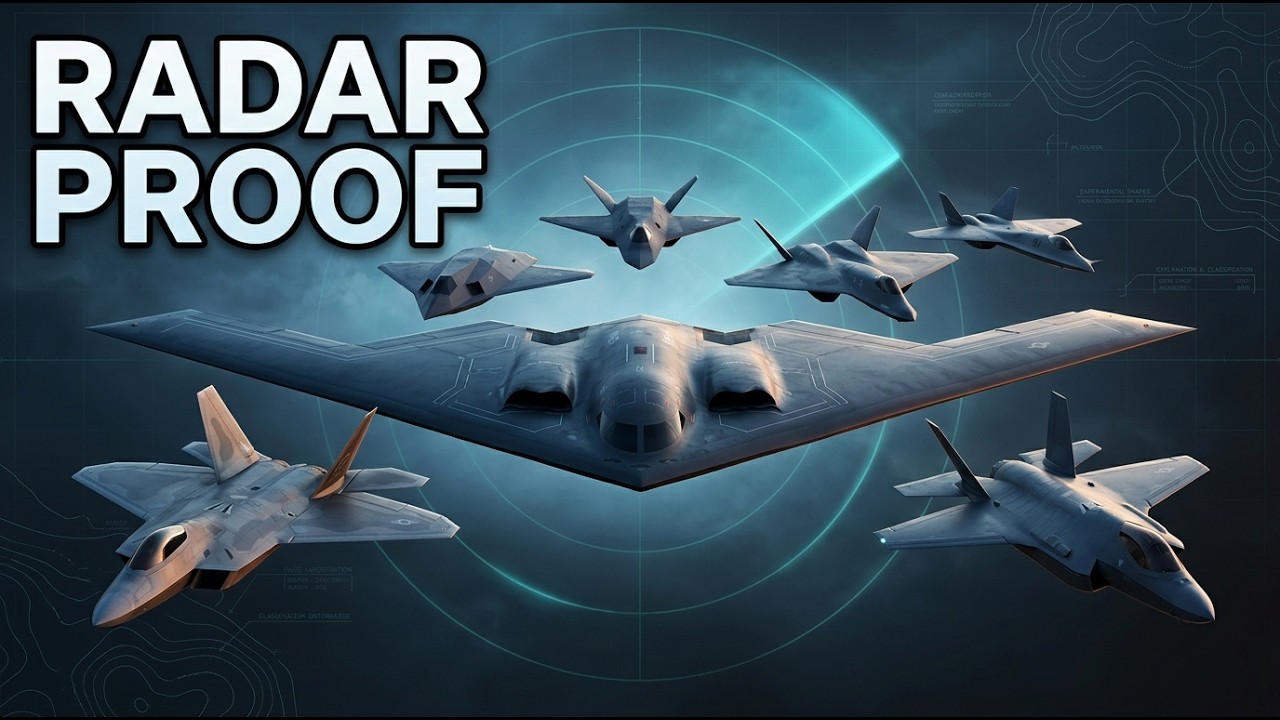
A stealth aircraft evades radar detection by scattering or absorbing electromagnetic waves rather than reflecting them back to a receiver, making the aircraft appear as little more than background noise on an enemy screen. This capability emerges from the careful integration of aerodynamic shaping, radar-absorbing materials, thermal management, and electronic warfare systems — a discipline formally known as low-observable technology. Aircraft like the F-22 Raptor, B-2 Spirit, and F-35 Lightning II represent the pinnacle of this engineering challenge, designed to penetrate the most heavily defended airspace on Earth without being detected.
Key Takeaways
- Stealth aircraft reduce their radar cross-section (RCS) by using angled surfaces that deflect radar energy away from the source rather than reflecting it back.
- Radar-absorbing materials (RAM) convert incoming electromagnetic energy into heat, further suppressing radar returns.
- Heat signature reduction — through engine placement, exhaust shielding, and airframe cooling — is as critical as radar stealth for survivability.
- Modern stealth design balances all electromagnetic signatures: radar, infrared, acoustic, and visual, rather than focusing on radar alone.
What Is Radar Cross-Section and Why Does It Matter?
Radar works by emitting pulses of radio waves and listening for the echoes that bounce back from objects in the sky. The strength of that returning echo is quantified as radar cross-section (RCS), measured in square meters. A conventional fighter jet like the F-16 has an RCS roughly equivalent to a large bird — perhaps 1 to 5 square meters. The F-22 Raptor, by contrast, is reported to have an RCS closer to a steel marble: approximately 0.0001 square meters. That is a reduction of roughly four to five orders of magnitude.
Reducing RCS is not simply a matter of making an aircraft smaller. It requires every surface, edge, inlet, and cavity to be deliberately engineered so that radar energy is either scattered harmlessly away from the transmitting antenna or absorbed before it can return. Even a single poorly designed panel edge or an open weapons bay can multiply an aircraft's RCS by a factor of thousands during the moments it is exposed.
The Role of Angular Geometry
The most visually striking feature of any stealth aircraft is its unconventional shape. The F-117 Nighthawk, the world's first operational stealth aircraft, looks almost like a faceted gemstone — all flat panels and sharp angles. This was not an aesthetic choice. Flat, angled surfaces redirect radar waves in specific, predictable directions rather than scattering them diffusely back toward the radar source. By aligning all surface edges to a small number of angles, designers ensure that strong radar reflections occur only at specific, known angles — none of which point back at a threat radar in operationally likely geometries.
Later aircraft like the B-2 Spirit and F-22 Raptor refined this concept dramatically. Instead of crude facets, they use carefully computed curved surfaces and blended edges that still redirect radar energy while also providing superior aerodynamic performance. The B-2's flying wing configuration eliminates the vertical tail surfaces that are large radar reflectors on conventional aircraft, wrapping everything into a single smooth, sculpted planform. Every edge on the F-22 — from its wing leading edges to its weapons bay doors — is aligned to one of just two or three specific angles, a technique called 'edge alignment,' which concentrates any residual radar return into narrow spikes that are easy for mission planners to manage.
Radar-Absorbing Materials
Shape alone cannot eliminate all radar return. Radar-absorbing materials (RAM) provide the second layer of defense. These coatings and structural composites are engineered at the molecular level to convert incoming electromagnetic energy into heat through resistive and magnetic loss mechanisms, rather than reflecting it.
Early RAM coatings, used on the SR-71 Blackbird and U-2, were relatively crude iron-ball paints — iron carbonyl particles suspended in a resin matrix. Modern RAM is far more sophisticated. The F-117 was covered in a radar-absorbing composite tile system that required intensive maintenance and was sensitive to moisture and handling damage. The F-22 and F-35 use co-cured RAM — absorbing material embedded directly into the structural composite panels during manufacturing — reducing maintenance burden while improving durability. Some coatings are frequency-selective, tuned to absorb the specific radar bands most commonly used by surface-to-air missile systems and airborne intercept radars.
Managing Infrared and Thermal Signatures
Radar is only one detection method. Modern air defense systems also rely heavily on infrared search-and-track (IRST) sensors, which detect the heat emitted by aircraft engines and aerodynamic friction. A stealthy aircraft that is invisible to radar can still be tracked by its thermal glow, so reducing infrared signature is equally important.
Engine placement is the first line of defense. On the B-2, the four jet engines are buried deep within the flying wing structure, with S-curved intake ducts that hide the hot engine face — one of the most powerful radar and infrared reflectors on any aircraft — from direct line of sight. Exhaust nozzles on stealth aircraft are carefully shaped to mix hot exhaust gases with cooler ambient air as rapidly as possible, reducing the thermal plume. The B-2 uses a unique slot exhaust configuration that spreads hot gases across the upper surface of the wing, dramatically cooling them before they become visible to rear-aspect infrared sensors.
The F-22 uses two-dimensional thrust-vectoring nozzles rather than round ones, which reduces the radar and infrared signature of the exhaust section while also providing exceptional maneuverability. The F-35 pushes this further with a diverterless supersonic inlet design that eliminates the boundary layer diverter — a gap between the fuselage and intake that creates a powerful radar return — replacing it with a carefully shaped bump that manages airflow without creating a detectable cavity.
Internal Weapons and Aperture Management
One of the most operationally significant stealth design decisions is the use of internal weapons bays. Hanging missiles and bombs under the wings of a conventional fighter eliminates stealth almost entirely — external pylons and weapons create enormous radar returns. Every stealth aircraft carries its primary weapons payload internally, releasing them through bay doors that open briefly, release the weapon, and close again.
But open weapons bays are themselves a serious radar problem. A rectangular cavity facing a radar source can act like a corner reflector, producing a signature far larger than the aircraft itself. Stealth designers address this with serrated bay door edges — the characteristic zigzag pattern visible on the F-22's and F-35's landing gear doors and weapon bay openings — which scatter rather than focus radar returns. Some designs also use plasma or active cancellation approaches to suppress cavity resonance during the brief moments the bays are open.
The same challenge applies to every aperture on the aircraft: sensor windows, cockpit canopies, and even panel gaps. The F-22 and F-35 use canopy coatings that are transparent to visible light but reflective to radar frequencies, preventing the large cockpit cavity from acting as a radar trap. Every panel gap across the fuselage is filled with conductive gaskets and aligned to the same edge angles used across the rest of the airframe.
Electronic Warfare and Active Stealth
Physical stealth reduces the signal an enemy radar receives. Electronic warfare multiplies that advantage by actively deceiving or jamming the radar systems trying to find the aircraft. The F-35 carries the AN/ASQ-239 electronic warfare suite, which provides both passive detection of threat radar emissions and active jamming capability. The F-22 uses the AN/ALR-94 system, which can detect, classify, and geolocate enemy radar emitters with extraordinary precision — sometimes to within a few meters — using the aircraft's own apertures as a distributed sensor array.
This combination of passive low observability and active electronic attack creates a layered defense that is qualitatively different from either capability alone. A stealth aircraft can approach a target while remaining silent electronically, then use brief, precisely aimed jamming pulses to suppress residual detection opportunities without revealing its position through broad-spectrum jamming emissions.
Modern Stealth Drones and the Future
Unmanned stealth aircraft — including the RQ-170 Sentinel, X-47B, and emerging systems like the B-21 Raider — extend these principles further. Without a pilot, designers are freed from the constraints of cockpit placement, g-force limits, and life-support systems, allowing even more aggressive shaping and materials choices. The B-21 Raider, which entered production in the early 2020s, is expected to incorporate lessons from decades of F-22 and F-35 operational experience into a more maintainable and adaptable platform, with a low-observable design optimized for the latest generation of integrated air defense systems that use long-wavelength, multi-static, and passive radar approaches specifically designed to counter traditional stealth geometries.