A small modular reactor (SMR) is a nuclear fission power plant with an output typically under 300 megawatts-electric that is factory-built and transportable, rather than constructed piece by piece on-site like a conventional gigawatt-scale plant. SMRs represent not a single technology but a broad family of at least 23 distinct reactor architectures, each optimized for a different combination of cost, safety, fuel cycle, heat output, and deployment scenario. From truck-deployable microreactors to offshore floating plants, the SMR landscape is reshaping how engineers think about nuclear energy in the 21st century.
Key Takeaways
- SMRs are defined by outputs below roughly 300 MWe and factory-modular construction, enabling faster deployment and lower upfront capital cost than large conventional reactors.
- The major SMR families include integral pressurized water reactors, boiling water designs, molten salt reactors, gas-cooled pebble-bed reactors, sodium-cooled fast reactors, and heat-pipe microreactors.
- Many advanced SMR designs use TRISO fuel — ceramic-coated microspheres that physically cannot melt — providing an inherent safety advantage over traditional fuel rods.
- Several SMR concepts are designed for non-electric applications including process heat, hydrogen production, and desalination, greatly expanding the potential market beyond grid power.
What Makes a Reactor 'Small and Modular'?
The International Atomic Energy Agency defines SMRs as reactors with a power output up to 300 MWe, though many designs target 50–100 MWe or even single-digit megawatts in the microreactor category. The 'modular' part refers to factory fabrication: major components are manufactured at a central facility, shipped by rail, road, or sea, and assembled at the deployment site. This approach is borrowed from industries like aerospace and shipbuilding, where quality control improves dramatically when work happens in a controlled factory environment rather than outdoors on a remote construction site.
Modularity also enables incremental capacity addition. A utility can install one 100 MWe module and add more as demand grows, rather than committing billions of dollars to a single large plant years before the first electron reaches the grid. This changes the financial risk profile of nuclear power considerably.
Integral Pressurized Water Reactors (iPWR)
The most mature SMR family takes the dominant reactor technology of the 20th century — the pressurized water reactor — and integrates all primary-loop components (steam generators, pressurizer, control rod drives) inside a single pressure vessel. Conventional large PWRs connect these components through external large-bore piping, which represents a major source of potential loss-of-coolant accidents. By eliminating that external piping entirely, iPWRs remove the accident scenario altogether through design, not through added safety systems.
NuScale Power's VOYGR is the leading Western example: twelve 77 MWe modules share a common pool of water, providing passive decay-heat removal for an indefinite period with no operator action and no AC power. Rolls-Royce SMR in the UK targets 470 MWe per unit — larger than most SMRs but still modular in construction approach. China's ACPR-50S and the Argentine CAREM are further examples. The technology readiness of iPWRs is higher than almost any other SMR family because the underlying neutron physics and materials science are well understood from decades of naval and commercial PWR operation.
Boiling Water SMRs
Boiling water reactors operate at lower pressure than PWRs and produce steam directly in the reactor vessel, eliminating the need for separate steam generators. GE-Hitachi's BWRX-300, rated at 300 MWe, is the most prominent boiling water SMR. It inherits its design lineage from the proven ESBWR, reducing the number of pumps and valves dramatically through natural circulation and passive safety systems. The BWRX-300 has attracted interest from utilities in Canada, Poland, and the United States as a near-term deployment candidate requiring relatively modest regulatory novelty.
Molten Salt Reactors (MSR)
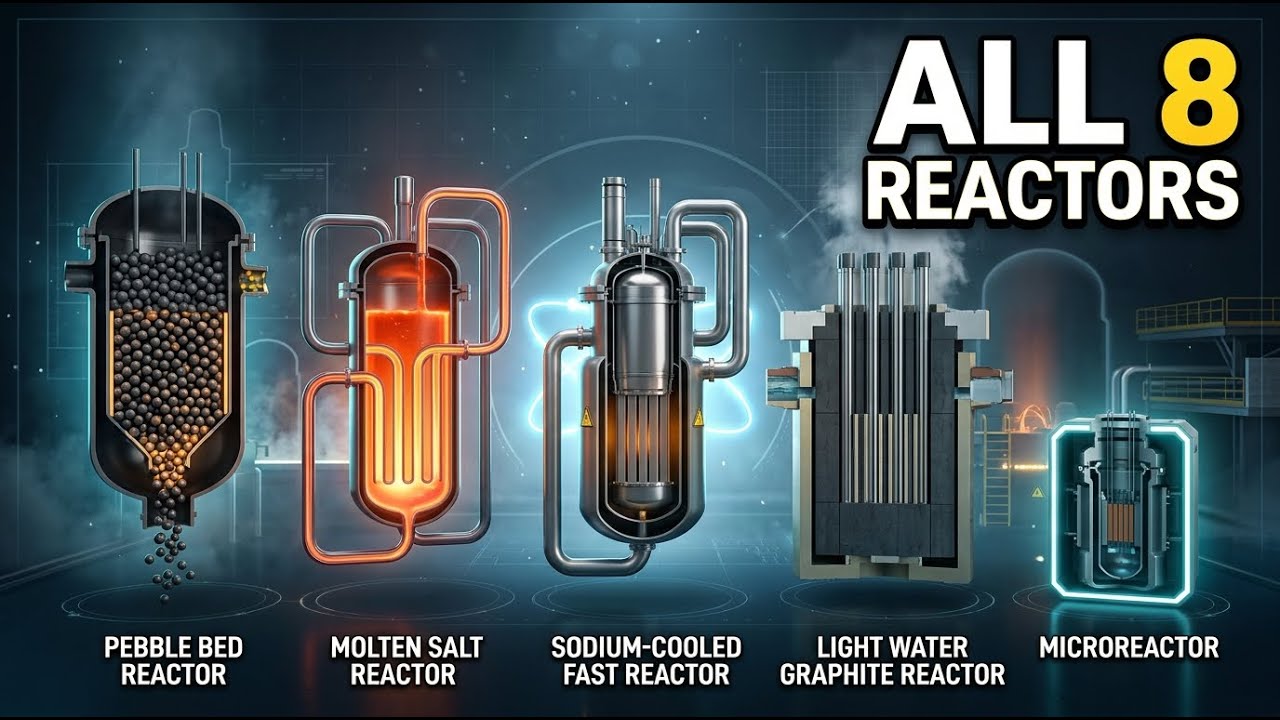
Molten salt reactors represent one of the most radical departures from conventional nuclear design: the fuel is dissolved directly into a liquid fluoride or chloride salt mixture that circulates through the reactor core. Because the fuel is already a liquid, there is no solid fuel rod to melt — a traditional nuclear accident scenario is simply not applicable. If the reactor overheats, a frozen salt plug at the bottom of the vessel melts passively and drains the fuel into subcritical storage tanks, stopping the reaction without any operator intervention or powered systems.
MSRs operate at atmospheric pressure (unlike PWRs which operate at ~155 bar), which dramatically simplifies the pressure vessel and containment requirements. They can also consume thorium as a fuel — an element roughly three times more abundant in Earth's crust than uranium — and can be configured to breed new fissile material or to burn long-lived actinide waste from conventional reactors. Terrestrial Energy (Canada), Moltex Energy, and Kairos Power are among the companies advancing MSR designs, with Kairos using solid TRISO fuel pebbles immersed in a fluoride salt rather than a dissolved fuel, combining advantages of both approaches.
Gas-Cooled and Pebble-Bed Reactors
High-temperature gas-cooled reactors (HTGRs) use helium or carbon dioxide as coolant instead of water. Because helium is chemically inert and has no neutron-absorption penalty, these reactors can reach coolant outlet temperatures of 700–950°C — far above what water-cooled reactors can achieve. This high-grade heat opens doors to industrial process heat applications, thermochemical hydrogen production, and high-efficiency Brayton cycle power conversion.
The pebble-bed variant loads fuel into billiard-ball-sized graphite spheres containing thousands of TRISO fuel particles. These pebbles circulate continuously through the reactor, with fresh pebbles added at the top and spent ones removed at the bottom — enabling online refueling without shutdown. China's HTR-PM, which began commercial operation in 2023, connects two pebble-bed modules to a single 210 MWe turbine and represents the most advanced operational HTGR in the world. X-energy's Xe-100 is the leading Western pebble-bed SMR, targeting 80 MWt per module with four modules per plant site.
Sodium-Cooled Fast Reactors (SFR)
Sodium-cooled fast reactors use liquid sodium metal as coolant and operate without a neutron moderator, meaning neutrons travel at higher energies ('fast' spectrum). This fast spectrum enables these reactors to fission transuranic waste that would otherwise remain radioactive for tens of thousands of years, effectively burning nuclear waste as fuel. SFRs can also breed more fissile plutonium-239 from uranium-238 than they consume — a 'breeder' mode that could extend uranium resources by a factor of 60 or more.
The engineering challenges are significant: sodium burns violently if exposed to water or air, requiring careful secondary loop design to keep radioactive primary sodium isolated from steam generators. TerraPower's Natrium reactor (345 MWe) pairs a sodium-cooled fast reactor with a molten salt thermal energy storage system, allowing the plant to discharge up to 500 MWe for peak demand periods — effectively functioning as both a baseload nuclear plant and a grid-scale battery.
Heat-Pipe Microreactors
At the smallest end of the SMR spectrum sit heat-pipe microreactors, which use no pumps, no coolant loops, and no pressurized systems whatsoever. Heat pipes — sealed tubes containing a working fluid that evaporates at the hot reactor core and condenses at the cold power conversion end — transfer heat entirely through passive two-phase thermodynamics. The entire reactor unit can fit in a standard shipping container, be airlifted by military cargo aircraft, and begin producing 1–5 MWe within days of arrival at a remote site.
DARPA and the US Department of Defense have funded the Demonstration Using Flared Location of an Atomic Reactor (PELE) project specifically for forward operating base power. NASA and the Department of Energy's Kilopower project demonstrated a heat-pipe microreactor prototype at full power in the Nevada desert in 2018, targeting lunar and Mars surface power applications. Oklo's Aurora compact fast reactor is pursuing commercial licensing for remote community and industrial applications.
Floating and Marine SMRs
Russia's Akademik Lomonosov, commissioned in 2020, demonstrated the concept of a floating nuclear power plant: two 35 MWe KLT-40S naval reactor units mounted on a barge, providing power and heat to the remote Arctic city of Pevek. China's ACPR-50S and several other designs are targeting offshore deployment, which moves construction to established shipyards, removes the plant from seismic hazard zones entirely, and provides infinite passive cooling from the surrounding ocean.
TRISO Fuel: The Safety Technology Underpinning Multiple SMR Families
Many of the most innovative SMR designs share a common fuel technology: TRISO (tristructural isotropic) particles. Each TRISO particle is a uranium fuel kernel roughly 1 mm in diameter, coated with four successive layers of carbon and silicon carbide. This ceramic shell acts as a miniature pressure vessel and containment barrier. TRISO particles have been tested to temperatures exceeding 1600°C without failure — well above any credible accident temperature — meaning fission products are physically retained inside the fuel particle even if all cooling is lost. When billions of these particles are embedded in graphite pebbles or cylindrical compacts, the result is a fuel assembly that simply cannot undergo a Chernobyl-style meltdown by the laws of physics.
Comparing SMR Families: Key Trade-offs
- Technology readiness: iPWRs and BWR SMRs lead; MSRs and SFRs require more regulatory pathway development.
- Temperature and applications: Gas-cooled HTGRs deliver the highest temperatures for industrial heat; water-cooled designs are limited to ~325°C.
- Fuel cycle: SFRs and MSRs offer waste-burning and breeding capabilities; iPWRs use conventional enriched uranium fuel.
- Deployment flexibility: Heat-pipe microreactors and floating designs offer the greatest siting freedom; large SMRs like BWRX-300 still require substantial civil infrastructure.
- Safety philosophy: All modern SMR designs rely on passive safety — gravity, convection, and material properties — rather than active pumps and operator actions.