NASA missions work by combining human ingenuity, rocket propulsion, and precision engineering to place spacecraft, rovers, telescopes, and astronauts exactly where science demands — from low Earth orbit to the edge of the solar system. Since the agency's founding in 1958, NASA has executed programs spanning human spaceflight, deep-space exploration, planetary science, and Earth observation, collectively producing more scientific discovery per dollar than almost any other institution in history. Understanding these missions chronologically reveals not just what we found, but why each program was the essential stepping stone to the next.
Key Takeaways
- NASA was established in 1958 and has since launched more than 46 major mission programs covering human spaceflight, planetary exploration, space telescopes, and Earth science.
- The Apollo program remains the only effort in history to land humans on another world, doing so six times between 1969 and 1972.
- Robotic missions like Voyager, Hubble, and the Mars rovers have fundamentally changed our understanding of the solar system, deep space, and the origins of the universe.
- The Artemis program aims to return humans to the Moon as a proving ground for eventual crewed missions to Mars, using the Space Launch System and the Orion capsule.
The Pioneer Era: Mercury and Gemini (1958–1966)
NASA's earliest human spaceflight programs had a single overriding goal: prove that people could survive and work in space before the Soviet Union made it irrelevant. Project Mercury (1958–1963) flew six astronauts on suborbital and orbital flights, with Alan Shepard becoming the first American in space in May 1961 and John Glenn becoming the first American to orbit Earth in February 1962. These missions validated life-support systems, reentry physics, and the basic physiology of spaceflight in microgravity.
Project Gemini (1961–1966) was NASA's critical bridge program — ten crewed missions that developed the techniques Apollo would need. Gemini astronauts performed the first American spacewalks (EVAs), mastered orbital rendezvous and docking, and proved that humans could endure the two-week-duration flights a lunar mission would require. Without Gemini's methodical rehearsals, Apollo could never have succeeded on its aggressive timeline.
The Moon Landings: Apollo (1961–1972)
The Apollo program is the most ambitious engineering undertaking in human history. Spanning 17 missions — including test flights, the near-fatal Apollo 1 fire that killed three astronauts on the pad in 1967, and the legendary Apollo 13 emergency in 1970 — the program achieved six successful lunar landings between July 1969 and December 1972. Apollo 11 carried Neil Armstrong and Buzz Aldrin to the Sea of Tranquility on July 20, 1969, fulfilling President Kennedy's 1961 challenge with five months to spare.
The scientific returns were extraordinary. Apollo astronauts returned 842 pounds (382 kg) of lunar rock and soil samples, installed seismometers and retroreflectors still in use today, and proved that the Moon formed from debris ejected when a Mars-sized body struck early Earth. Apollo 17's Harrison Schmitt became the only professional geologist to walk on the Moon, spending three days conducting detailed fieldwork in the Taurus-Littrow valley. The program's abrupt end after Apollo 17 remains one of the most debated decisions in the history of exploration.
Robotic Explorers: Pioneer, Voyager, and the Outer Solar System
While astronauts were walking on the Moon, robotic probes were racing outward. Pioneer 10 and 11 (launched 1972–1973) became the first spacecraft to cross the asteroid belt and fly through the outer solar system, revealing that the giant planets' radiation belts were navigable. They also carried the famous Pioneer plaques — the first physical messages to any potential extraterrestrial civilization.
Voyager 1 and Voyager 2 (launched 1977) conducted the 'Grand Tour,' exploiting a rare planetary alignment to visit Jupiter, Saturn, Uranus, and Neptune in a single extended mission. Their imagery transformed these worlds from points of light into places: active volcanoes on Io, complex ring systems at Saturn, the mysterious smooth ice of Europa suggesting a subsurface ocean, and the violent winds of Neptune's atmosphere. In 2012, Voyager 1 became the first human-made object to enter interstellar space — it is still transmitting data today from more than 23 billion kilometers away.
The Space Shuttle Era and the International Space Station (1972–2011)
The Space Shuttle program was NASA's attempt to make spaceflight routine and economical through a reusable launch vehicle. Flying 135 missions between 1981 and 2011, the shuttle deployed satellites, conducted microgravity research, serviced the Hubble Space Telescope in five critical repair missions, and constructed the International Space Station (ISS) module by module over thirteen years. The Challenger disaster in 1986 and the Columbia disaster in 2003 killed 14 astronauts and forced painful reassessments of NASA's safety culture.
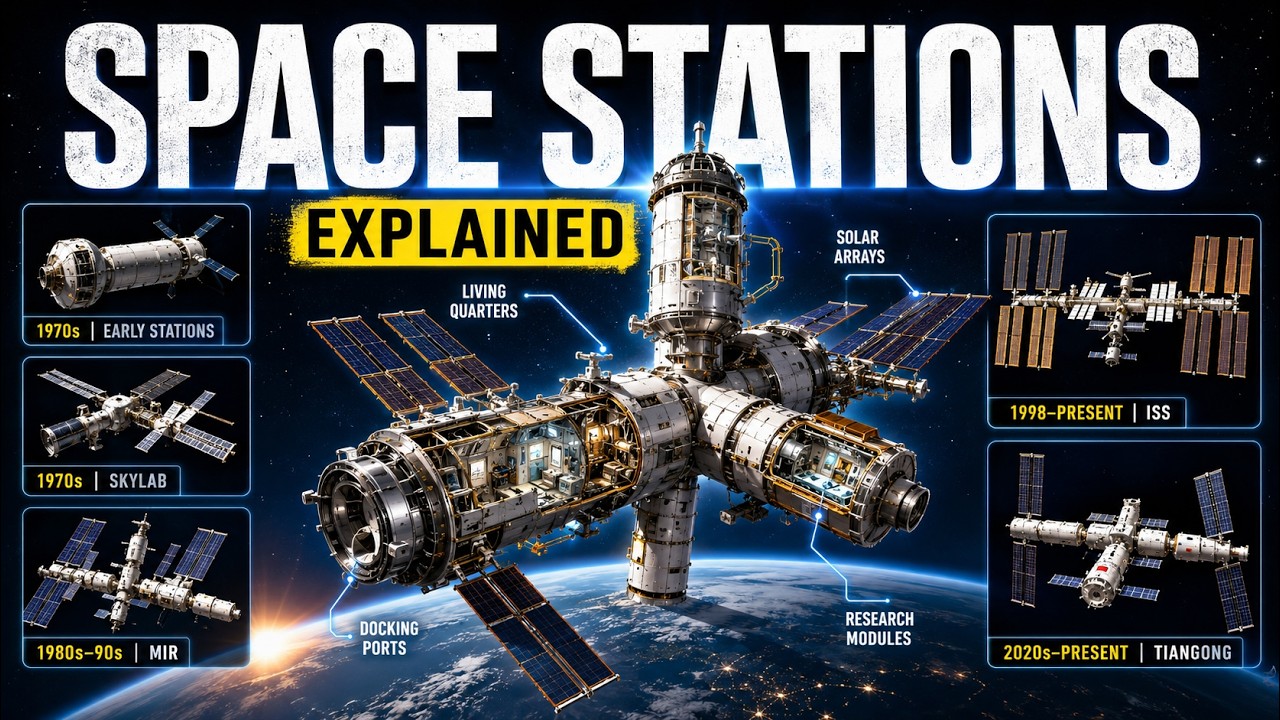
The ISS itself — a joint project of NASA, Roscosmos, ESA, JAXA, and CSA — has been continuously inhabited since November 2000, hosting more than 270 people from 20 countries and serving as humanity's only long-duration orbital laboratory. Research conducted aboard has advanced our understanding of bone density loss, fluid dynamics in microgravity, plant biology, and the long-term effects of cosmic radiation on the human body — all critical for planning future deep-space missions.
Eyes on the Universe: Hubble, Chandra, Spitzer, and James Webb
NASA's Great Observatories program deployed four flagship space telescopes designed to observe the universe across the electromagnetic spectrum. The Hubble Space Telescope, launched in 1990 and famously repaired after a flawed mirror was discovered, has produced some of the most iconic scientific images in history — from the Hubble Deep Field revealing thousands of galaxies in a patch of sky smaller than a grain of sand held at arm's length, to detailed studies of dark energy's accelerating expansion of the universe.
The Chandra X-ray Observatory (launched 1999) reveals the universe's most violent phenomena — black hole jets, supernova remnants, and galaxy cluster collisions — in high-energy X-ray light. The Spitzer Space Telescope (2003–2020) operated in infrared, peering through dust clouds to image star nurseries and the first atmospheres of exoplanets. The James Webb Space Telescope, launched on December 25, 2021, combines a 6.5-meter gold-coated mirror with mid-infrared sensitivity to observe the universe's first galaxies, characterize exoplanet atmospheres, and study star formation with unprecedented resolution — images released in 2022 immediately surpassed Hubble in depth and clarity.
Mars: Landers, Rovers, and the Search for Life
No planet has received more robotic attention than Mars. The Viking landers (1976) were the first spacecraft to successfully operate on the Martian surface and conducted the first biological experiments looking for signs of life — results that remain ambiguous to this day. Mars Pathfinder and its Sojourner rover (1997) proved that mobile rovers were feasible. Spirit and Opportunity (2004) discovered conclusive mineralogical evidence that liquid water once existed on the Martian surface. Opportunity drove 45 kilometers before contact was lost in 2018.
Curiosity (landed 2012, still operating) has climbed Mount Sharp inside Gale Crater for over a decade, drilling rock samples and identifying organic molecules and seasonal methane fluctuations. Perseverance (landed 2021) is the most capable rover ever built, equipped with instruments to seek biosignatures in ancient lake sediments and to cache rock samples for a future sample-return mission. Its companion, the Ingenuity helicopter, became the first powered aircraft to fly on another planet — completing over 70 flights before its rotors were damaged in January 2024.
Beyond the Planets: Asteroid and Comet Missions
NEAR Shoemaker became the first spacecraft to orbit and land on an asteroid when it touched down on Eros in 2001. The OSIRIS-REx mission (2016–2023) traveled to the potentially hazardous asteroid Bennu, mapped its surface in extraordinary detail, and returned a 121-gram sample to Earth in September 2023 — the largest asteroid sample ever delivered, containing pristine organic material from the early solar system. Its successor, OSIRIS-APEX, is now en route to the asteroid Apophis for its 2029 close Earth flyby. The New Horizons probe delivered humanity's first close-up views of Pluto in 2015, revealing a geologically active world with nitrogen ice plains, mountain ranges, and a hazy atmosphere.
The Next Giant Leap: Artemis and the Return to the Moon
The Artemis program is NASA's plan to return humans to the Moon for the first time since 1972, this time with the explicit goal of establishing a sustainable presence rather than conducting brief surface visits. Artemis I (2022) flew an uncrewed Orion capsule around the Moon and back, validating the Space Launch System — the most powerful rocket NASA has ever built — and the capsule's heat shield at lunar return velocities. Artemis II will carry four astronauts on a lunar flyby, and Artemis III aims to land the first woman and first person of color on the lunar south pole, a region of permanent shadow harboring water ice deposits critical for long-term habitation and propellant production. The Lunar Gateway — a small space station in lunar orbit — will serve as a waypoint for surface sorties and, ultimately, as a staging point for crewed Mars missions planned for the 2030s and 2040s.