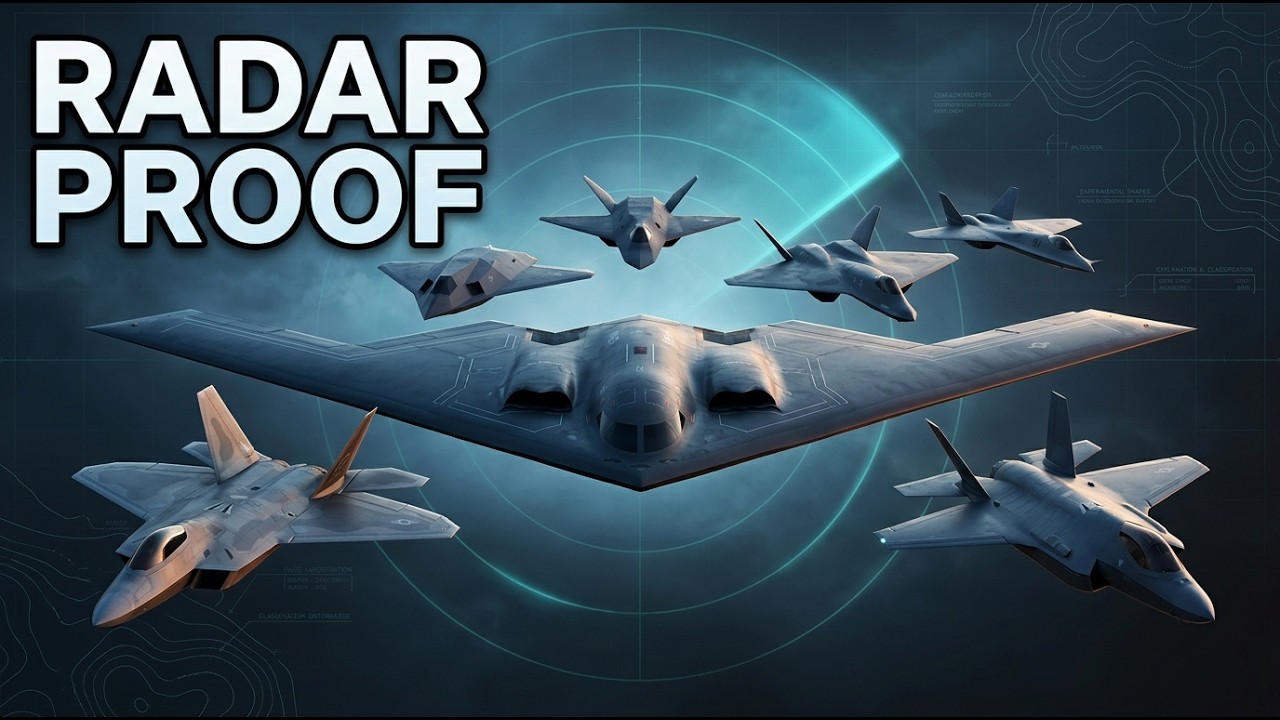
The B-2 Spirit stealth bomber works by combining a tailless flying wing airframe, radar-absorbing surface coatings, and carefully buried engines to reduce its radar cross-section to roughly the size of a large bird. Developed by Northrop Grumman for the United States Air Force and first flown in 1989, the B-2 is designed to penetrate the most heavily defended airspace on Earth and deliver conventional or nuclear weapons with precision. Understanding how it achieves this requires looking at its shape, its materials, its propulsion, and the flight control systems that replace the tail surfaces found on virtually every other aircraft.
Key Takeaways
- The B-2 Spirit is a flying wing aircraft with no vertical tail, which dramatically reduces its radar cross-section compared to conventional bomber designs.
- Its surfaces are coated with radar-absorbing materials that convert radar energy into heat rather than reflecting it back to enemy receivers.
- Four General Electric F118 turbofan engines are buried deep inside the wing to hide their heat signatures and inlet geometry from radar and infrared sensors.
- Flight stability and control are managed entirely by computers and split drag rudders at the wing tips, replacing the functions of a conventional tail.
Why the B-2 Has No Tail
On a conventional aircraft, the vertical tail serves two critical purposes: it provides directional stability and it houses the rudder, which steers the nose left and right. The problem is that a vertical tail is a powerful radar reflector. Its flat, upright surface bounces radar waves directly back toward the emitting antenna, creating a strong return signal that ground-based or airborne radar systems can easily detect. The B-2 eliminates the vertical tail entirely, adopting a pure flying wing configuration where the entire aircraft is one continuous, carefully shaped wing with a 172-foot span.
Without a tail, the B-2 relies on split drag rudders embedded at each wingtip. These panels can open like a clamshell, increasing drag on one side or the other to yaw the aircraft left or right. Elevons — control surfaces that blend the function of elevators and ailerons — handle pitch and roll. Because the flying wing configuration is inherently unstable, a fly-by-wire flight control computer makes thousands of corrections per second to keep the aircraft on course. The pilot provides inputs, but the computer continuously interprets and executes them to maintain controlled flight.
The Shape That Defeats Radar
Stealth is not just about materials — geometry is equally important. Radar works by sending out radio waves and listening for reflections. Any flat surface or sharp angle that faces the radar will send energy back as a strong return signal. The B-2 is designed so that almost all of its surfaces are angled to deflect radar energy away from the source rather than back toward it.
The leading edge of the wing meets the airflow at a carefully calculated sweep angle of 33 degrees. Every panel line, every door seam, and every edge on the aircraft is aligned parallel to either the leading or trailing edge of the wing. This is called edge alignment, and it ensures that radar reflections are scattered in predictable directions — none of which point back at enemy radar antennas. The result is a radar cross-section estimated at around 0.1 square meters, comparable to a large bird or a small metal sphere, despite the aircraft being 69 feet long and weighing over 150,000 pounds at maximum takeoff weight.
Radar-Absorbing Materials and Coatings
Shape alone is not enough to achieve the B-2's level of stealth. The aircraft's surface is covered with radar-absorbing materials, commonly abbreviated as RAM. These materials contain microscopic particles — typically iron ball paint or carbon-based compounds — that interact with incoming radar waves and convert the energy into heat through resistive loss, rather than reflecting it.
The B-2's RAM coating is notoriously demanding to maintain. The aircraft must be hangared in climate-controlled facilities, and after each mission the coating is inspected and repaired where necessary. Even small gaps or damaged patches can degrade stealth performance significantly. The Air Force operates dedicated climate-controlled hangars at Whiteman Air Force Base in Missouri, where the entire B-2 fleet is based. This maintenance overhead is one of the primary reasons the aircraft costs so much to operate — the Air Force estimates a cost of approximately 135,000 dollars per flight hour.
Buried Engines and Heat Signature Management
Radar is only one way an aircraft can be detected. Modern air defense systems also use infrared sensors that can pick up the heat generated by jet engines. The B-2 addresses this with its four General Electric F118-GE-100 turbofan engines, which are buried deep inside the wing structure rather than hanging in exposed nacelles beneath the wings.
The engine inlets are positioned on top of the wing, meaning they are not visible from below. The inlet geometry is carefully shaped with a curved S-duct that hides the fan blades from radar waves that might otherwise reflect off their rotating surfaces. Jet exhaust is expelled through narrow, slot-shaped nozzles at the trailing edge of the wing, which mix hot exhaust gases with cooler air and force them to exit at a low angle relative to the horizon. This reduces the aircraft's infrared signature both from the ground and from heat-seeking missiles approaching from the rear.
Mission Capability: Range, Payload, and Weapons
The B-2 Spirit has an unrefueled range of approximately 6,000 nautical miles, which can be extended to global range with aerial refueling. A single B-2 can fly from Whiteman Air Force Base in Missouri to a target anywhere on Earth, deploy its weapons, and return — a mission profile that has been demonstrated in actual combat operations in Kosovo, Afghanistan, Iraq, and Libya.
The aircraft carries weapons in two internal bays, which keeps them shielded from radar until the moment of release. Maximum payload is approximately 40,000 pounds. The B-2 can carry up to 80 conventional 500-pound Mk-82 bombs, 16 joint direct attack munitions, or large penetrating weapons like the Massive Ordnance Penetrator, a 30,000-pound bunker-busting bomb designed to destroy deeply buried hardened facilities. In the nuclear role, it carries the B61 or B83 gravity bombs.
How All the Systems Work Together
What makes the B-2 remarkable is not any single technology but the integration of all these systems into a coherent platform. The flying wing shape minimizes radar returns. The RAM coating absorbs what little radar energy still reaches the surface. The buried engines hide the most thermally and electromagnetically visible components. The edge-aligned panel lines scatter reflections away from radar receivers. And the fly-by-wire flight control system makes the otherwise unstable flying wing flyable by human pilots.
The aircraft also uses a low-probability-of-intercept radar system called the AN/APQ-181, which emits radar signals in ways that are difficult for enemy receivers to detect and geo-locate. When the B-2 needs to navigate or find targets, it can do so without giving away its position to passive electronic surveillance systems.
Only 21 B-2 Spirits were built before production ended in 1997, at a unit cost that reached approximately 2.1 billion dollars per aircraft when development costs are included. One aircraft, the Spirit of Kansas, was lost in a crash at Andersen Air Force Base in Guam in 2008, leaving 20 aircraft in the operational fleet. Despite its age, the B-2 remains the world's only low-observable strategic bomber in service, and the United States Air Force continues to upgrade its systems while its successor, the B-21 Raider, enters production.